


Materials and finishes for false ceilings and walls
December 19, 2025
Keywords:
False ceilings and false walls, materials, finishes, choice of materials, guide, L'Artificio
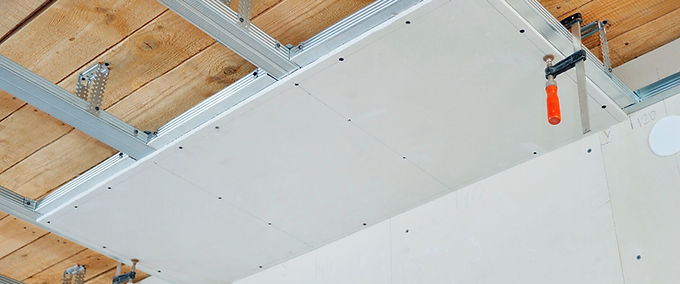
The most commonly used material for false ceilings and walls is plasterboard , consisting of coated plasterboard panels mounted on a lightweight metal structure. It's an extremely versatile solution: it allows for the creation of flat surfaces, recesses, recesses, niches, curved structures, and integrations with LEDs and spotlights. Depending on your needs, the panels can be standard, water-repellent for humid areas, or specifically designed for fire resistance.
In more technical contexts or where high performance is required, fiberboard or composite systems with high-density panels come into play. These materials offer greater strength, improved acoustic performance, and, in some cases, improved impact resistance, making them useful in corridors, public spaces, high-traffic areas, and spaces where heavy items (wall units, equipment, large lighting fixtures) will be anchored.
An important aspect concerns sound-absorbing systems. Micro-perforated panels, slats, and sheets with specific holes or milling, combined with acoustic mats placed behind the surface, help reduce reverberation and improve sound comfort. In restaurants, open-plan offices, classrooms, and meeting rooms, the use of sound-absorbing false ceilings significantly changes the perception of the environment, making conversations clearer and reducing diffuse noise.
For accessible suspended ceilings, modular systems are often used: plasterboard, mineral fiber, metal, or composite panels supported or attached to an exposed structure. These solutions allow easy access to the systems above, making them very practical in offices, shops, and spaces where system changes are frequent.
As for finishes , false ceilings and walls can be painted with matte or satin paints, covered with wallpaper, decorative wood panels, stretched fabrics, or three-dimensional elements. A matte white false ceiling can fade completely into the background, while a false wall can take center stage thanks to intense colors, light beams, and materials that contrast with the rest of the room.
Choosing the right system depends on many factors: available height, existing utilities, acoustic requirements, furnishing style, and maintenance options. Evaluating these variables during the design phase allows suspended ceilings and false walls to transform from simple "coverings" into true interior design tools.
Highlight
• They allow the integration of systems, lighting and technical passages without demolishing existing structures.
• Wide choice of slabs: standard, hydro, fire-resistant, acoustic, with high surface hardness.
• Smooth, continuous finishes that can be painted like normal walls and ceilings.
• Possibility of creating veils, steps, light cuts and decorative volumes in addition to the simple “closure”.
Low Light
• By reducing the internal heights, they can make already small spaces appear more “low”.
• Standard plates are sensitive to humidity if used where they are not intended.
• An incorrect choice between normal, hydro or REI sheets can create performance problems over time.


