
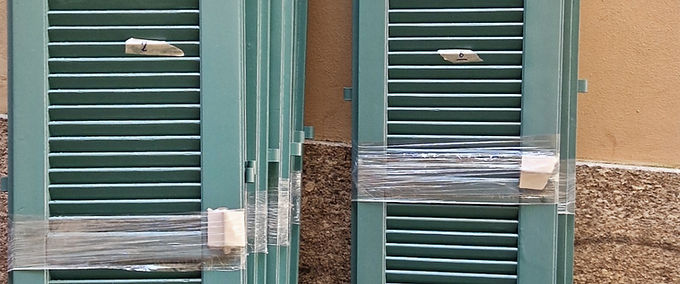
Materials and finishes for wooden shutters and blinds
October 9, 2025
Keywords:
Wooden shutters and blinds: colors, facades, styles, combinations, L'Artificio
When it comes to wooden shutters and blinds, we often think only of the final color. In reality, the key is the type of wood and how it was processed. Modern systems almost always use laminated wood , obtained by gluing selected strips with opposing grains: this reduces the warping, twisting, and cracking typical of solid wood exposed outdoors. The most common types are fir, pine, larch, oak, and other resistant species, often treated in an autoclave or with deep-seal impregnators.
The shutter structure is designed to withstand the elements: uprights, crosspieces, and slats (in louvered shutters) must have the correct thickness, carefully designed joints, and glues suitable for outdoor use. In solid shutters, the interplay between boards, frames, and any textured or smooth panels defines style and durability.
On the protection front , impregnating agents, primers, and varnishes come into play. Water- or solvent-based impregnating agents penetrate the wood, highlighting its grain, and protecting it from humidity, UV rays, and fungi. They can be transparent , leaving the natural tone visible, or pigmented, to even out the color and improve light resistance. Film-forming finishes are often applied over the impregnating agent: semi-transparent varnishes, covering enamels, and multi-layer systems that create a continuous protective film.
Water-based paints are increasingly popular for environmental reasons and ease of application: they dry quickly, have less odor, and offer good performance when used in full cycles. Opaque enamels allow you to completely change the look of shutters, transforming grained wood into a uniform surface, often matching the color of the window frames or facade.
Construction details also play an important role: well-crafted drip edges to wick away water, rounded or protected end caps, silicone and seals in the right places, stainless steel or hot-dip galvanized hardware to resist corrosion. All these details, even if they're barely visible, impact the longevity of the faucet.
The choice of system depends on the context: in areas highly exposed to sun and rain, it's best to opt for higher-performance woods and paint systems; on historic facades, a more natural finish or a specific color, coordinated with any constraints, may be preferable. In any case, considering maintenance, exposure, and the building's style from the outset helps avoid having beautiful shutters only in the first few years.
Highlight
• Laminated wood reduces warping and deformations compared to traditional solid wood.
• Suitable impregnating agents and painting cycles protect against humidity, UV rays and fungi.
• Full-coverage nail polishes and transparent finishes allow you to range from a natural to a more contemporary look.
• Construction details such as drip edges, protected end caps and correct hardware have a significant impact on overall durability.
Low Light
• Cheap or inadequately treated woods suffer more under severe exposure.
• Improvised or incomplete painting cycles drastically reduce the useful life of the shutters.
• Overly glossy finishes can highlight defects and small movements in the wood over time.


